Wooden Roulette Wheel Rim Tolerances and Humidity Challenges in Tropical Resorts
Vera Reed · Jul 23, 2026
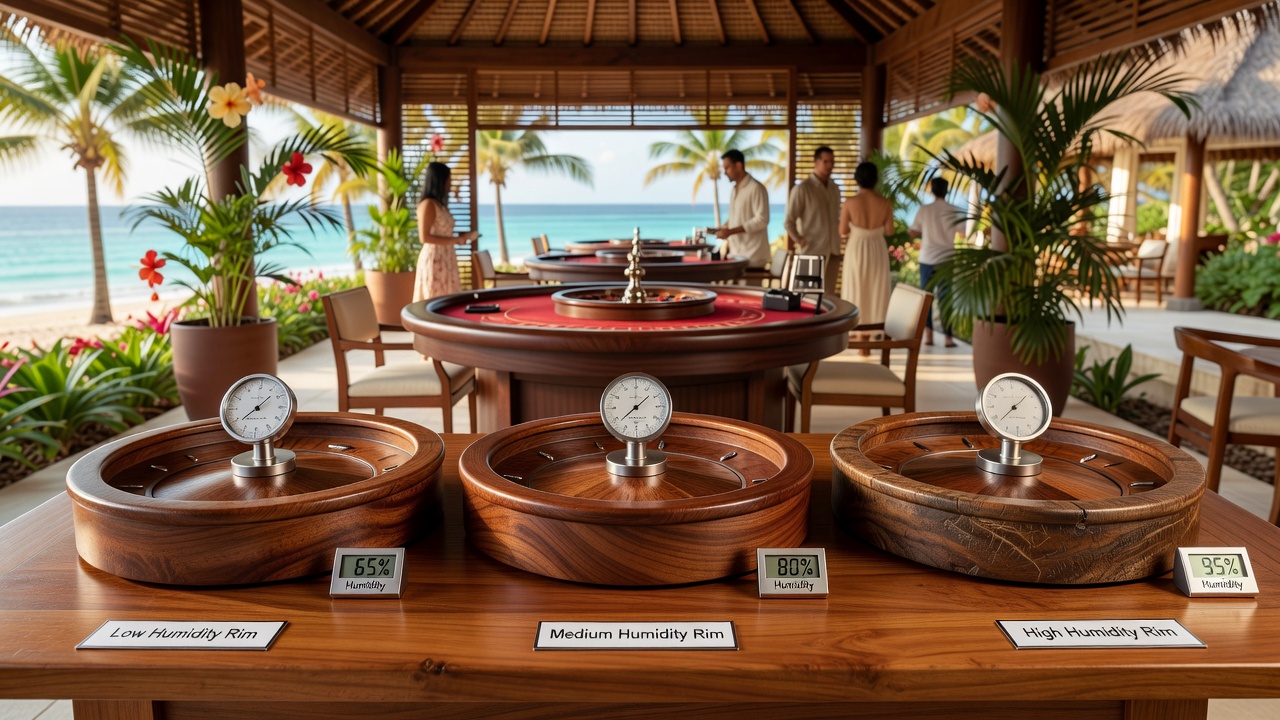
Wooden Roulette Wheel Rim Tolerances and Humidity Challenges in Tropical Resorts
Engineers design roulette wheel rims from select hardwoods because these materials offer natural density and vibration damping properties that metal alternatives struggle to match, yet the same characteristics make them sensitive to moisture absorption in tropical environments where relative humidity often exceeds 80 percent year-round. Casino operators in these regions track dimensional changes closely because even minor swelling or contraction in the rim can shift the wheel's balance point and alter ball trajectory paths during play. Data collected from multiple venues shows that rim diameters typically range between 80 and 90 centimeters with manufacturing tolerances held to plus or minus 0.15 millimeters to satisfy regulatory fairness requirements.
Material Properties and Construction Methods
Manufacturers select species such as maple or cherry for their straight grain patterns and low natural resin content, then laminate multiple layers under pressure to reduce warping risks while preserving the circular integrity needed for consistent spin dynamics. CNC machining follows lamination to achieve the precise groove depths and lip angles that guide the ball, and each finished rim undergoes laser scanning before shipment to verify compliance with those tight specifications. Observers note that facilities in Southeast Asia and the Caribbean often receive wheels pre-acclimated at the factory to an average humidity of 55 percent, which creates an initial mismatch when the equipment arrives at sites where ambient moisture levels fluctuate between 70 and 90 percent.
Humidity Impact on Dimensional Stability
Wood fibers absorb and release water vapor through their cell walls, causing tangential expansion that can reach 0.25 percent per 10 percent rise in relative humidity according to forestry research conducted at institutions across the Asia-Pacific region. In practice this means a roulette rim might grow radially by several tenths of a millimeter during the wet season, enough to push the assembly outside its original tolerance band and require recalibration of the spindle bearings. Resorts in Singapore and Macau have documented seasonal patterns where wheel maintenance logs show increased adjustment frequency between May and September when monsoon influences elevate moisture content in the gaming halls.
Monitoring and Adjustment Protocols
Technicians install digital hygrometers directly on the wheel stands to record micro-climate data every fifteen minutes, then compare those readings against rim circumference measurements taken with calibrated micrometers at the start of each shift. When expansion exceeds 0.20 millimeters, crews loosen the mounting clamps and allow controlled drying periods inside dehumidified storage rooms before reinstalling the component, a process that can take between four and six hours depending on the severity of the shift. July 2026 records from several island properties revealed that proactive monitoring reduced unplanned downtime by 37 percent compared with previous years when adjustments occurred only after performance complaints emerged.

Regulatory Standards Across Jurisdictions
Authorities in different tropical gaming markets impose varying inspection intervals, with some requiring third-party verification of wheel geometry every 90 days while others accept operator self-certification supported by logged data. A study published by researchers at the University of the West Indies examined five Caribbean facilities and found that wheels maintained under active climate control stayed within tolerance 94 percent of the time, whereas those exposed to fluctuating air conditioning cycles showed deviations 2.3 times more frequently. These findings prompted several operators to integrate automated ventilation systems that stabilize hall humidity within a two percent band.
Long-Term Mitigation Approaches
Some venues now specify composite rim cores wrapped in thin hardwood veneers to limit moisture exchange while retaining the aesthetic and acoustic qualities players expect, and early field reports indicate these hybrid designs reduce seasonal adjustments by roughly half. Others apply specialized sealants that slow vapor transmission without adding measurable weight or altering spin characteristics, though reapplication becomes necessary every 18 to 24 months. Facilities that combine sealed rims with continuous environmental monitoring report the most stable performance metrics over multi-year periods.
Conclusion
Engineering tolerances for wooden roulette wheel rims remain achievable in tropical casino resorts when operators combine material science knowledge with consistent environmental controls and scheduled measurement routines. Data from multiple properties demonstrate that proactive management of humidity effects preserves the precision required for regulatory compliance and uninterrupted table operation, while emerging hybrid construction methods offer additional pathways for reducing maintenance demands in high-moisture climates. Continued collaboration between manufacturers, regulators, and resort engineering teams supports ongoing refinement of these practices across global gaming destinations.