Inside the workshops where casino-grade playing cards receive their signature edge treatments and finishes
David Schmitt · Jun 18, 2026

Inside the workshops where casino-grade playing cards receive their signature edge treatments and finishes
Workshops dedicated to casino-grade playing cards focus on edge treatments that extend beyond basic cutting, incorporating finishes designed for durability, shuffle consistency, and security features that meet strict operational demands across gaming venues worldwide. These facilities combine precision machinery with manual oversight to produce decks that withstand thousands of shuffles while maintaining uniform performance. According to data from the Nevada Gaming Control Board, standards for card integrity influence everything from table game speed to fraud prevention protocols in regulated environments.
Edge treatments typically begin after the initial printing and lamination stages, where sheets of high-grade paper or plastic composites receive their first protective layers. Workers then move the material to specialized stations equipped with rotary cutters and coating applicators that apply micro-layers of varnish or polymer blends along each card's perimeter. This process creates the beveled or rounded edges that reduce friction during dealing and help cards slide smoothly across felt surfaces without catching. The reality is that even minor variations in edge angle can affect how decks perform in automated shufflers used by many large operators.
Precision machinery and material handling
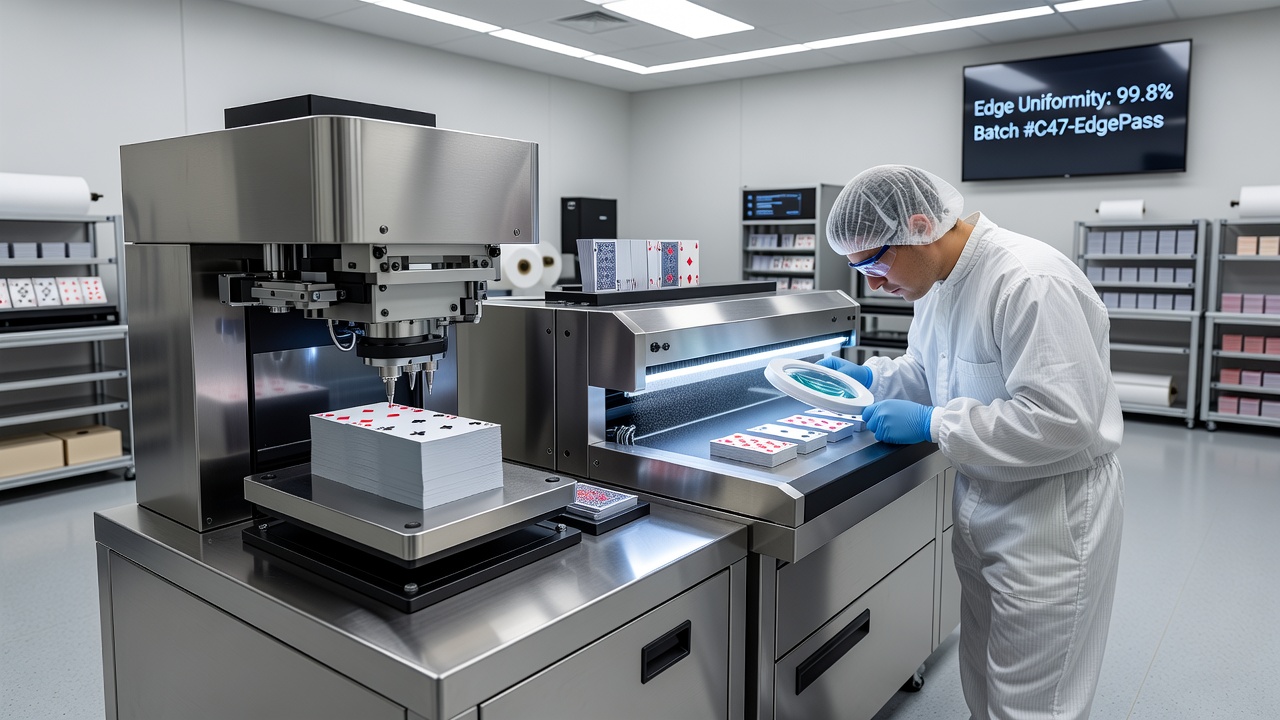
Modern workshops rely on computer-controlled equipment to achieve tolerances measured in fractions of a millimeter, yet human technicians still handle critical inspection points where automated systems fall short. Sheets pass through stations that apply heat and pressure to seal edges, followed by cooling periods that lock in the finish. Researchers at the University of Nevada, Las Vegas documented how polymer edge coatings contribute to extended deck life in high-volume settings, noting measurable reductions in wear after 500 shuffles compared to untreated stock. Observers note that facilities often maintain separate clean rooms for final finishing to prevent dust particles from embedding in fresh coatings.
Materials range from traditional 100% cotton paper stocks to hybrid polymer blends that resist moisture absorption during extended play. Edge treatments frequently include subtle embossing or micro-texturing that serves both functional and security purposes, allowing dealers and surveillance teams to detect marked or altered cards more readily. Data shows these features integrate with broader manufacturing standards tracked by industry groups such as the European Gaming and Betting Association, which compiles regional compliance metrics across multiple jurisdictions.
Quality assurance protocols in production
Each batch undergoes layered testing that includes visual scans, weight verification, and shuffle simulations before packaging. Technicians examine edges under magnification for uniformity, rejecting any cards that display irregularities in coating thickness or bevel symmetry. Those who've studied production flows point out that facilities schedule maintenance cycles around peak demand periods, ensuring equipment calibration remains consistent even as output scales. In June 2026, several manufacturers reported upgrades to their edge-finishing lines to accommodate new polymer formulations that improve resistance to ultraviolet degradation during storage and transport.
Case studies from large suppliers reveal that edge treatment represents one of the final value-added steps before decks receive their tamper-evident seals and enter global distribution networks. The process integrates with earlier stages such as die-cutting and corner rounding, creating a seamless transition that preserves the structural integrity of each card. What's interesting is how these workshops coordinate with regulatory bodies in different regions, adapting finishes to comply with local specifications without altering core performance characteristics.
Security features embedded during finishing
Edge treatments sometimes incorporate covert markers or UV-reactive inks applied during the coating phase, allowing for rapid authentication under specialized lighting. These additions occur after primary finishes have been set, ensuring the security elements do not compromise the tactile qualities required for professional handling. Figures from Australian regulatory reports indicate that enhanced edge security measures have contributed to lower incident rates in monitored gaming environments over recent years. Workshops maintain detailed logs of each production run, tracking variables such as coating viscosity and application temperature to support traceability requirements.
Training programs for technicians emphasize both mechanical operation and quality judgment, since automated systems still require periodic human intervention when sensors detect anomalies. People who've examined workflow data note that edge treatment lines often run parallel to other finishing processes, allowing facilities to balance output across multiple product lines simultaneously. The global supply chain for these specialized cards depends on consistent workshop standards that align with international gaming equipment guidelines.
Conclusion
Workshops handling casino-grade playing card edge treatments continue to evolve their methods in response to technological advances and regulatory updates, maintaining focus on precision and consistency that support fair play across venues. Production data and compliance records demonstrate how these finishing stages contribute to the overall reliability of gaming operations worldwide.